

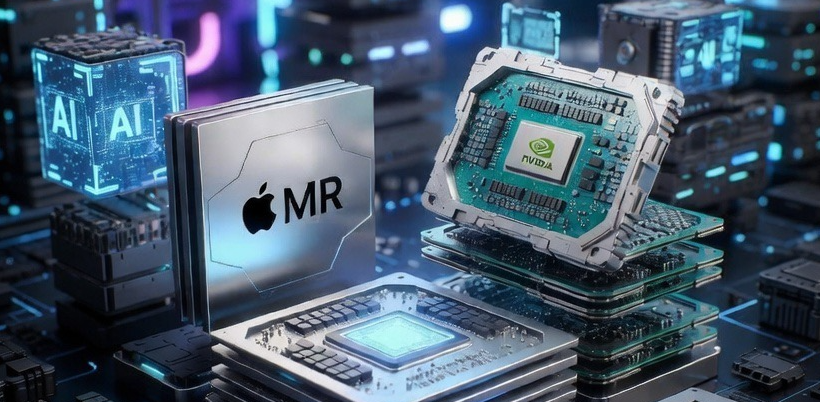
Here's a bold prediction: the most likely challenger to Nvidia's dominance in AI won't be AMD, Intel, or any semiconductor startup. It will be Apple — and its M-series chips. Apple's real AI strategy isn't about catching up. It's about waiting for a entirely different era to arrive: the age of the personal AI hub. As of March 2026, that prediction no longer needs defending. It's unfolding in real time.
Why Did Everyone Miss This?
For the past several years, every serious conversation about AI has revolved around Nvidia. H100s, Blackwell, data centers, the CUDA ecosystem — this has been the dominant narrative, and almost nothing else. Apple? That’s the company that makes phones. Sure, their laptop chips are impressive, but AI? That’s Nvidia’s game. That judgment missed something fundamental: Apple and Nvidia were never competing on the same battlefield. Nvidia’s business is selling shovels to gold miners. Its customers are Google, Meta, and Microsoft — organizations that need to train massive AI models at scale. The market is enormous, and Nvidia executes it flawlessly. But Apple has been eyeing a different mine entirely: the billions of devices sitting in people’s pockets, and the fabric of everyday life that surrounds them.
Apple’s “Patience” Was Never Weakness — It Was Strategy
Apple has never been loud about AI. It didn’t publish foundation models like Google. It didn’t weaponize open-source releases like Meta. Instead, it quietly made each generation of the M-series Neural Engine more powerful, refined its Unified Memory Architecture, and pushed the efficiency of on-device inference closer and closer to the limit. That’s not falling behind. That’s a deliberate choice. Apple’s chosen direction is what it calls Personal Intelligence: the idea that AI shouldn’t live on a remote server. It should live on your device — understanding your habits, protecting your privacy, available at the moment you need it, without shipping your data to the cloud and waiting for an answer to come back. For years, that philosophy outpaced the hardware capable of delivering it. M5 changed that.
M5: The Hardware Finally Catches the Vision
The M5 chip delivers roughly 45% GPU performance gains over M4, with AI peak performance improving more than 4x thanks to Neural Engine integration across its architecture. Unified memory bandwidth reaches 153GB/s — enough for a Mac to run 70B parameter language models entirely on-device, with no cloud dependency and no Nvidia GPU in sight. The more telling comparison is power efficiency. A Mac Studio M5 Ultra consumes approximately one-tenth the power of an Nvidia H100, while still processing large language models at 17–18 tokens per second locally. For inference-heavy workloads — the kind that define personal AI use cases — that ratio is decisive. This is what Apple was waiting for: a generation of silicon capable of actually delivering on the personal AI hub vision.
Baltra: The Final Piece of the Puzzle
Apple’s ambitions don’t stop at the device level. Internally codenamed “Baltra,” Apple’s AI server chip — developed in collaboration with Broadcom — is purpose-built for inference, not training. It’s expected to enter mass production in the second half of 2026, with deployment to Apple’s own data centers planned for 2027. The distinction matters: Baltra isn’t designed to train foundation models. It’s designed to run them efficiently, at scale, within Apple’s own infrastructure. Put the pieces together and a coherent picture emerges. M-series chips handle roughly 90% of everyday AI tasks on-device. When more complex requests require additional compute, they route to Private Cloud Compute powered by Baltra — entirely within Apple’s ecosystem, never touching a third-party server. This isn’t Apple trying to out-Nvidia Nvidia. This is Apple constructing a parallel world that Nvidia never thought to build.
The Real Competition Is About Choosing the Battlefield
To be clear: Nvidia’s dominance in AI training is not under threat anytime soon. The raw compute of the Blackwell architecture and the depth of the CUDA developer ecosystem represent moats that take decades to build. Apple’s MLX framework is promising, but it’s not there yet. But the outcome of this competition won’t be decided by who wins on the other’s home turf. The real question is: as AI moves from data centers into personal devices, whose ecosystem becomes the default infrastructure? Nvidia has never seriously engaged with that question. Apple has spent five years building the answer.
2027: The Moment of Truth
The M6 generation is rumored to include a dedicated Transformer co-processor, further sharpening Apple’s edge in LLM inference. Baltra’s deployment will mark a qualitative shift in Apple’s private cloud capabilities. And the personal AI device market continues to expand as users grow increasingly aware of — and concerned about — where their data actually goes. 2027 may be when this prediction fully cashes out. Not because Apple defeated Nvidia. But because Apple will have proven something more interesting: that from the very beginning, it was playing an entirely different game.